Subscribe Now!
...with web-based news readers. Click your choice below:




...with other readers:

FeedBurner makes it easy to receive content updates in My Yahoo!, Newsgator, Bloglines, and other news readers.
Learn more about syndication and FeedBurner...
Current Feed Content
-
Four Color Freeze Frame: Uncle Scrooge and the Rocketeer
Posted: 2011-07-12 09:50:41 UTC-04:00
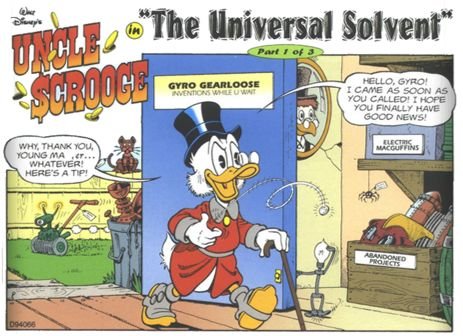
Consider this a mash-up of two of our more popular post categories: Freeze Frame! and Four Color Fun.
It is no secret that we are big fans of comic book artist and scribe Don Rosa. And he is not at all dissimilar to the clever Imagineers and animators whose hidden details we love to discover and celebrate. Don peppers his work with small details and clever references. In a previous post, we noted his homage to MGM cartoon characters drawn for comics by Disney Legend Carl Barks.Since we are celebrating the 20th anniversary of the feature film The Rocketeer this year, we thought we'd make note of Don's subtle reference to Dave Steven's iconic character. In his Uncle Scrooge story The Universal Solvent, Scrooge pays a visit to eccentric inventor Gyro Gearloose. In the opening splash panel where Scrooge enters Gyro's laboratory, the Rocketeer helmet and jetpack can be seen in a box labeled "ABANDONED PROJECTS."

-
Posted: 2011-07-09 07:27:16 UTC-04:00
Saturday at the Archives: On Wheels of Progress On Wheels of ProgressBy Jeffrey PepperOriginally published November 17, 2009
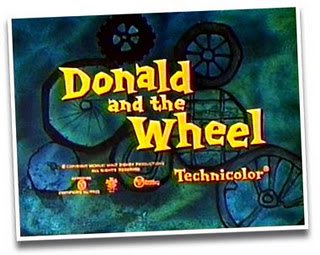 On September 29, 2006, a mere nine days into my blogging adventures, I wrote a very brief post about one of my most favorite pieces of Disney entertainment--the generally innocuous and now considerably obscure Donald Duck film Donald and the Wheel. I came to feel that my passion for this particular amalgamation of early xerography, rotoscoping and brief snippets of live action was a very rare emotion indeed. But I have come to discover fellow brothers in the Wheel cause who literally span the globe. So I have decided it is time again to celebrate this largely forgotten production that continues to gather dust in an unvisited corner of the Disney celluloid archives.
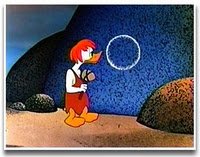 Donald and the Wheel was in fact part of one the most dramatic transitions in the history of Disney animation--the move away from hand-inked cels to the faster and more productive xerography process. Xerography was largely the innovation of resident studio technical genius Ub Iwerks. While 101 Dalmatians is most frequently heralded as the first major demonstration of the process, it was actually used experimentally in Sleeping Beauty, and tested more completely in the 1960 short subject Goliath II. But largely absent from the animation history books is the further exploration of xerography in Donald and the Wheel, which made its way into theaters a mere six months following the release of Dalmatians. Its eighteen month production schedule certainly crossed over with those of both Goliath II and Dalmatians.
An exhibitor's kit for Donald and the Wheel, though steeped heavily in PR prose, provided this generally informative background on the film's technical accomplishments:
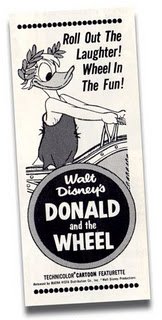 Walt Disney scores another entertainment first with his Technicolor cartoon featurette, "Donald and the Wheel." Using the revolutionary Xerox and Sodium Screen Processes together for the first time, Disney and his director, Ham Luske, combine real people and objects in the same perspective as animated characters and objects.
Telling the story of man's greatest invention, the wheel, required illustrations of many types of wheels and cogs, sometimes highly technical in nature. Instead of having an animator draw them, Disney had color film taken of wheels and transferred them to the screen with the Xerox Process.
For example, when a scene called for an illustration of the wheels used in a cotton gin, Eli Whitney's original invention was photographed and transferred to the screen.
With the Sodium Screen Process, Disney technicians were able to reduce a beautiful, auburn-haired ballerina to the size of Donald Duck and place her on a phonograph record with him.
The Sodium Process uses two films exposed simultaneously through the same lens, one sensitive to the Sodium screen, the other not. When the two are combined, a perfect silhouette is achieved, which is then superimposed on a master print.
The same kit provided this very detailed synopsis of the film:
In Walt Disney's newest Technicolor cartoon featurette, "Donald and the Wheel," Disney brings to the screen a story he has been working on for the past twenty years, man's greatest invention, the wheel.
The tale is told in rhyme with a pair of ghostly narrators, the Spirits of Progress, Sr., and Progress, Jr. The straight man is none other than Walt's old pal, Donald Duck, aptly arrayed in the garb of a cave man.
The faint figures of Progress, Sr. and Jr. watch a common, ordinary wheel rolling. Barrel-voiced Senior explains to bopster Junior that the wheel is man's greatest invention.
"Without the wheel, mankind would be at a standstill," he observes.
Junior disagrees. "What about the airplane, automobile, typewriter, steam engine, cotton gin, sewing machine and washing machine," says the boy.
Progress Senior strips each invention of all but its basic parts — wheels — and graphically proves his point, that the wheel, son, is man's greatest invention.
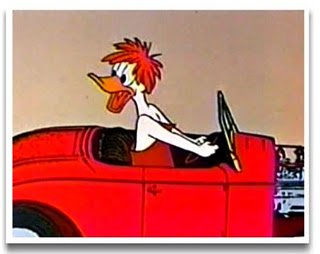 Caveman Donald, however, is harder to convince. The spirits take the little character on a meteoric ride from a circular drawing on a rock down through the ages to our present day hot rods. When Donald piles up his heap on the crowded freeways, he gives up.
"Who needs wheels," he says. "I'd rather walk."
The spirits try again by showing the duck that even the world spins like a wheel, that the solar system is really wheels within wheels, that a clock depends upon wheels, gears are adaptations of wheels, and finally, a music box works on wheels.
Music is to Donald's taste, it develops, especially when a beautiful redheaded dancer does a jazz number, a square dance and a ballet with him atop of an oversized, spinning phonograph.
The spirits have chosen the wrong cave man to invent the wheel, however. Donald scurries back to his cave, erases the circle drawn in the rock and pulls his wheel-less sled over the horizon.
"No thanks," says Donald, "I'm not going to be responsible for that thing."
Senior and Junior shrug off their disappointment, but are happy that some cave man, if not Donald, eventually did have the foresight to invent the wheel.
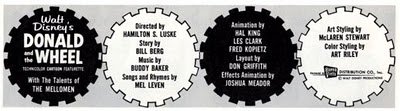 There are likely many who negatively view the film's mishmash of rough edged styles and and distinctly non-Disney techniques and would no doubt quantify it all as short-cut animation. But in the end, director Hamilton Luske and his crew crafted a charming, entertaining endeavor that successfully mixes humor, music and education. Unlike its much more popular but decidedly stuffier cousin Donald in Mathmagic Land, Donald and the Wheel appropriately moves along at a much more energetic pace, largely due to the the clever rhyming dialog and equally creative song lyrics provided by Mel Leven. The song "The Principle of the Thing," whose lyrics I excerpted in my earlier post, stands as a truly unrecognized gem from the studio's vast library of music. Thurl Ravencroft and his fellow MelloMen did justice to Leven's efforts, with Ravencroft himself performing the voice of the senior Spirit of Progress.
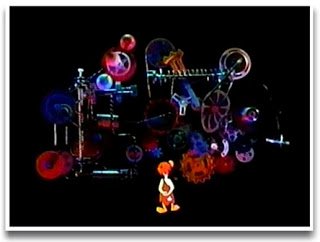 What is especially ironic about Donald and the Wheel is that our favorite duck essentially plays second fiddle to the rotoscoped silhouettes of Progress Jr. and Progress Sr. A generation gap-dynamic is played out by these two characters, highlighted by Junior's beatnik-speak, again cleverly realized in Leven's rhyming dialog.
"Gazooks, Pop! This cat is really nowhere! In some circles we'd call him square"
Through narration and song, these two Spirits of Progress elevate the film beyond the potentially dry history lesson it might have been otherwise. When they are taken out of the forefront in the story's slightly weaker jukebox-phonograph sequence, the pace noticeably slows, but recovers quickly when the duo return for the final fanfare.
The short recycled animation, most notably from the Pecos Bill sequence from Melody Time, then itself later had its own material recycled for the Ward Kimball-directed 1970s' television program Mouse Factory. The gear and cog contraption created during the "Principle of the Thing" song found its way into that show's opening montage. And in an example of typical Disney synergy, the film's subject matter, humorous tone and musical nature would resurface twenty years later in the form of EPCOT Center's World of Motion pavilion.
A comic book tie-in for Donald and the Wheel was released in 1961. It was featured in this prior post here at 2719.


-
Posted: 2011-07-02 06:20:21 UTC-04:00
Saturday at the Archivies: A Patron of the Clock StoreA Patron of the Clock StoreBy Jeffrey PepperOriginally published January 25, 2009
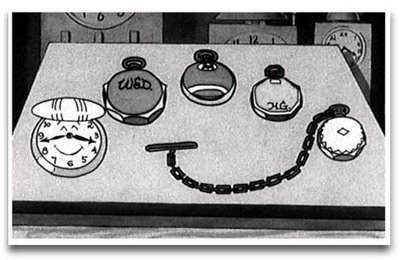 Even in the very early years of the Disney Studio, animators were paying homage to themselves and other studio personalities in the very cartoons they were producing. In the 1931 Silly Symphony The Clock Store, two pocket watches appear, marked with the engraved initials of their supposed owners. The initials W.E.D. are a quite obvious reference to Walter Elias Disney, but the initials of H.G. are a bit more mysterious.
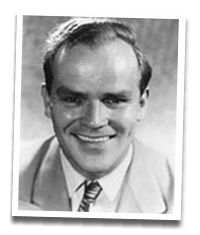 Digging into the the film's credits, as provided by Russell Merritt and J. B. Kaufmann in their book Walt Disney's Silly Symphonies, we discover that this particular sequence was animated by a gentleman named Hardie Gramatky.
Gramatky worked at the Walt Disney Studios from 1929 until 1936. On the website www.gramatky.com, Gramatky's daughter Linda Gramatky Smith notes:
"He went to Chouinard art school at night and to the Studio during the day. His first job was to do a Disney comic book, but he finished six months of drawings in three days when Walt asked him, 'Gee, Hardie, what would you like to do now?' Dad told Walt that he'd like to try animation. There were only fourteen animators there when he arrived (and 250 when he left for New York in 1936)."
 In a 1938 interview with the Los Angeles Times, Walt Disney said of Gramatky, "There was a boy working for us who had a great future in our Studio. But his heart wasn't in his work and he decided to chuck it all and paint what he wanted to paint. We gave him a great send-off because we admired his spirit. He had a struggle, but he arrived. Even when he was struggling he was happy for he was doing what he wanted to do."
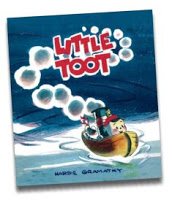
Gramatky would go on to become a well known artist and illustrator, perhaps most famous for his series of Little Toot childrens books. Disney would adapt Little Toot for the 1948 feature Melody Time. Gramatky was especially celebrated for his work with watercolors. In a 2006 magazine article, artist Andrew Wyeth named Gramatky as one of America's twenty greatest water colorists.
A footnote to the sequence from The Clock Store: The timepiece in the center is marked with the letter M, the meaning of which, if any, is a bit harder to decipher. The film's credits only list two individuals with names beginning with M: background artists Carlos Manriquez and Mique Nelson.
The Clock Store is available on DVD as part of the Walt Disney Treasures - More Silly Symphonies (1929-1938).


-
Vintage Snapshot! - Early Crate Parkeology
Posted: 2011-06-27 21:35:32 UTC-04:00
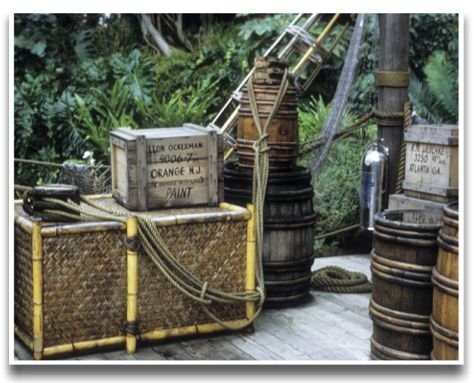
Among our favorite theme parkeology subjects here at 2719 Hyperion are crates. They are literally littered throughout all of the Disney parks, and Imagineers just love to label them with inside jokes and clever references. But here is in fact a Vintage Snapshot of early Walt Disney World crates with inscriptions that mean . . . nothing?
Dating from 1972, these Jungle Cruise crates bear reference to Leon Okerman and R. H. Jeschke. Okerman hails from 4006 7th Street in Orange, New Jersey, while Jeschke resides at 3250 9th Avenue in Atlanta, Georgia. Both addresses are non-existent, at least according to current street map resources. Okerman and Jeschke are especially unusual names but turn up virtually nothing from popular Internet search engines.Is it possible that Leon and R. H. sprang wholly from the imagination of an early Disney World Imagineer? Readers, I welcome whatever insight or theories you may have on this parkeological mystery.

-
Posted: 2011-06-24 22:27:18 UTC-04:00
Saturday at the Archives: Roadside Disney - Trailer Tales
Roadside Disney: Trailer Tales
By Jeffrey Pepper
Originally published May 6, 2008
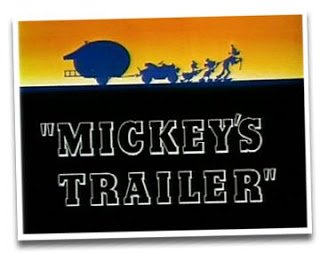 It is an icon of roadside popular culture. A home on the road for tin can tourists. Over the years, Disney cartoon makers incorporated the American travel trailer into a number of short subjects, but perhaps never more famously than in the Technicolor classic Mickey's Trailer, released on May 6, 1938.
Mickey's Trailer was not born out of happenstance. A mere decade earlier, everyman Arthur Sherman, a modest bacteriologist, turned the then fledgling auto camping movement on its ear when he introduced a solid-walled trailer that was devoid of the more traditional canvas and tent based designs that had been popular up to that point. Jokingly dubbed the "Covered Wagon" by Sherman's children, it would launch both a successful new industry and a popular culture phenomenon. In their book Ready to Roll: A Celebration of the Classic American Travel Trailer, authors Arrol Gellner and Douglas Keister elaborated on Sherman's unique achievement:
"Sherman's Covered Wagon Company was a rare success story in the bleakest years of the Depression, and naturally, it attracted notice—both from competitors and from the American press, who were desperate for stories containing some glimmer of economic hope. For their part, Sherman's competitors—including those who had specialized in all manner of sophisticated, fold-out gadgetry—were eventually obliged to adopt the Covered Wagon's hard-walled construction."
This Depression-era trailer boom reached a peak in 1936, followed quickly by an unpredicted and near devastating decline shortly thereafter. Manufacturers dramatically over predicted growth and demand and the bubble quickly burst. This was coupled with a sudden public disenchantment with many aspects of trailer culture. Gellner and Keister noted:
"The media's giddy, rose-colored accounts were gradually supplanted by more hostile examinations of the trailering phenomenon. Trailer parks were pilloried as a new kind of American slum-on-wheels and were even accused of being a breeding ground for epidemics, while trailerites were increasingly portrayed as freeloaders helping themselves to public roads and facilities without paying taxes for their support."
 When it was released in 1938, Mickey's Trailer encapsulated many of these both positive and negative associations. Via Walt's well known "Probable Impossible," the canned-ham style trailer featured in the short embodied with extreme exaggeration the trailer manufacturers much hyped claims of style, luxury and countless conveniences. Its interior featured a series of ingenious if not impossible transforming set pieces; a bunk room dramatically morphs into a bathroom (complete with sink and already filled bathtub) and then into its final incarnation as a dinette upon which Mickey serves up breakfast.
Yet the cartoon's creators, in a subtle yet still noticeable manner, poked fun at the various negative associations to trailer culture that began to emerge in the late 1930s. The short's opening reveal of the trio's city dump campsite is indicative of what Gellner and Keister described as local government fears of trailerite slums taking root on city outskirts. The perception of trailer campers as freeloaders is distinctly portrayed when Mickey, without conscience, absconds corn from a nearby farmer's field and similarly draws milk from a passing cow. The background music for that particular scene featured the song "The World Owes Me a Living."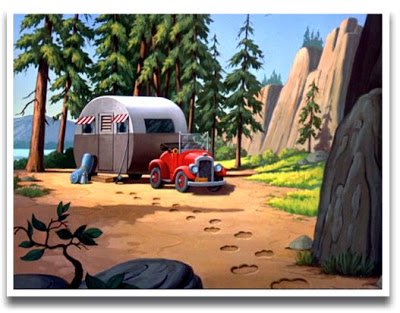 A post-World War II boom returned the travel trailer to a more than receptive American public. The industry itself experienced a distinct split as larger residence-based mobile homes became as equally popular as their recreational-centric counterparts. The smaller travel trailers became linked with then very popular outdoor sportsmen dynamics that included camping, hunting and fishing. This pop culture phenomenon was not lost on Disney animators; they used it to great effect in the 1950 Donald Duck cartoon Trailer Horn. A canned ham-style trailer is the focal point of Chip and Dale's inspired antagonism and Donald's resulting frustration.
In the 1952 cartoon Two Weeks Vacation, Goofy falls victim to a well known highway convention--getting stuck behind a lumbering, slow-moving car and trailer combination. Mixed in the short with the Goof's other road trip pratfalls is a recurring encounter with an oversize and impassable trailer. Similar gags would be revisited quite famously a couple of years later in the classic Lucille Ball-Desi Arnaz comedy The Long, Long Trailer.
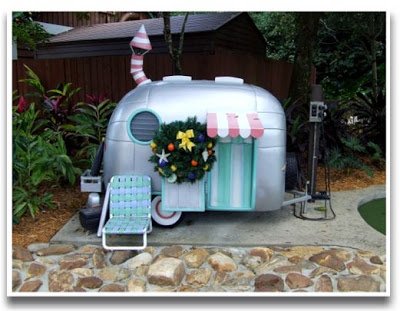
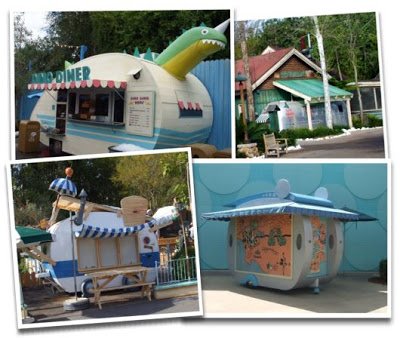 Disney Imagineers have similarly drawn inspiration from the travel trailer and have peppered Disney theme parks with numerous trailer-inspired set pieces. Trading on mid 20th century nostalgia are trailers that appear in Animal Kingdom's Dinoland, at Disney's Pop Century Resort and in Mickey's Toontown at Disneyland. Trailers were also a featured part of a character greeting area at Disney's Hollywood Studios prior to that particular location's current Pixar Studios redesign. But likely the most prominent use of travel trailers and their connection to roadside culture are the "Elfstream" designs found at Winter Summerland Miniature Golf at Walt Disney World. The theming mixes roadside campground nostalgia with retro Christmas trappings for a truly entertaining and often hilarious experience.
 Media Images © Walt Disney Company


-
Vacation Parade
Posted: 2011-06-21 08:17:18 UTC-04:00
2719 Hyperion will be operating on a reduced publishing schedule for the next couple of months as we navigate through summer vacations and a number of research and writing projects. We have maintained a rather aggressive level of ongoing publication since last fall and the summer months seemed an opportune time to temporarily scale back our efforts.We will continue with lighter content posts such as Snapshots and Freeze Frames and supplement those with selections from the 2719 Hyperion Archives. To our always enthusiastic and engaged readers--thank you for your encouragement and support. It is truly appreciated.

-
Freeze Frame! - The Truth was in There (Hercules)
Posted: 2011-06-20 05:04:52 UTC-04:00
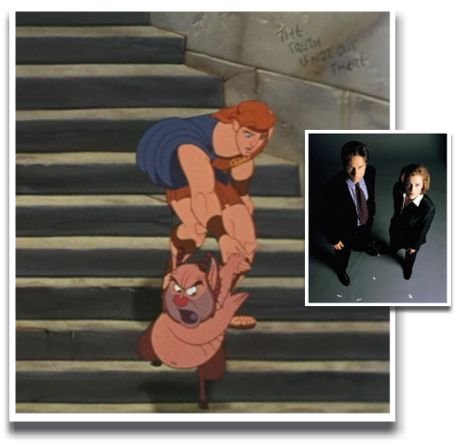
In 1997, the classic science fiction television show The X-Files was at the near-peak of its popularity. That is reflected in a subtle sight gag found within Hercules, the Disney animated feature film that was released that same year. Shortly after they arrive in Thebes, Hercules and Phil walk past graffiti that contradicts Agent Muldar's famous mantra that, "The truth is out there." No doubt there were at least a few X-Files aficionados on the Hercules crew.

-
Peter Pan's Four Color Treasure Chest
Posted: 2011-06-17 10:44:28 UTC-04:00
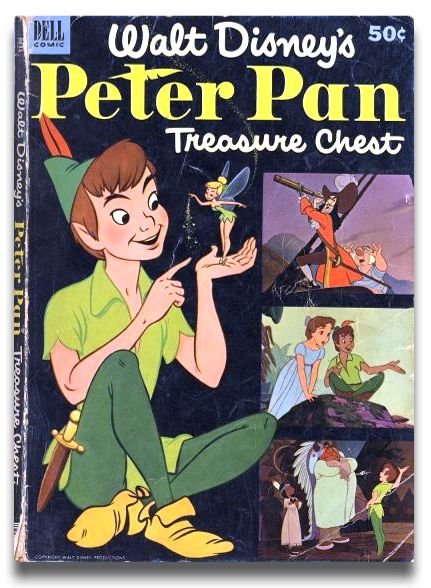
It was one of the heftiest comic books ever produced. Topping out at a whopping 212 pages, Walt Disney's Peter Pan Treasure Chest, published by Dell Comics, was released in early 1953 to coincide with the debut of Disney's animated feature Peter Pan in theaters. It cost a then allowance-draining fifty cents and has proven to be one of the rarer Disney comic books from that particular era. Copies now fetch between $200-$300.
A full quarter of the book was devoted to a 54-page adaptation of the movie. Two additional 20-page tales involved crossovers with Donald Duck and Mickey Mouse respectively. A 32-page story centering on Captain Hook and a search for buried treasure was loosely adapted from the classic 1942 comic Donald Duck Finds Pirate Gold by Carl Barks and Jack Hannah. Bubbles the Water Baby was a 12-page "story of the Mermaid Lagoon." Mr. Smee and Nana were showcased in their own shorter stories while John and Michael were teamed for an Indian Adventure that filled sixteen pages. Activity pages filled out the remainder of the book.
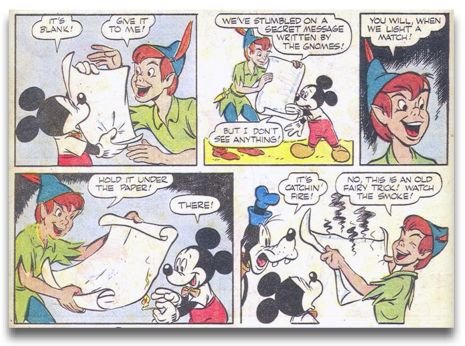
Mickey and Peter Pan from Walt Disney's Peter Pan Treasure Chest

-
The 1953 Peter Pan Marketing Machine
Posted: 2011-06-16 11:28:40 UTC-04:00
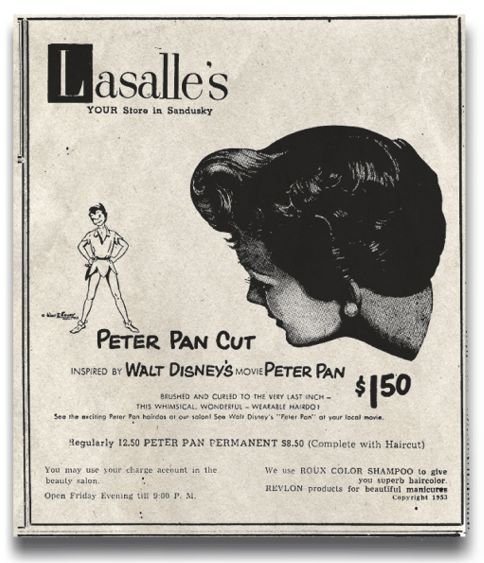
If you thought that far-reaching and media-saturating marketing campaigns were primarily a more contemporary Disney Company tactic, think again. In early 1953, it was difficult to open a newspaper and not be exposed to advertising featuring tie-ins to Peter Pan, which was released in February of that year. And if you thought that the products and services being endorsed were likely juvenile in nature, you would be most mistaken, as evidenced by the above-featured ad for the Peter Pan Haircut. Salons across the country offered the cut, as well as the Peter Pan Permanent. It was "brushed and curled to the very last inch--this whimsical wonderful wearable hairdo!"
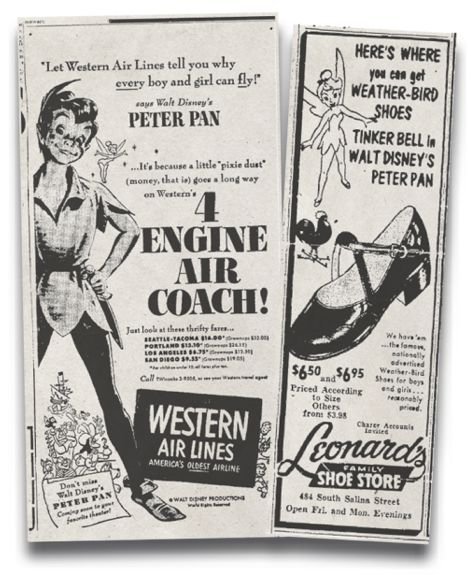
Other Pan-related campaigns included Western Airlines, that proclaimed, "Let Western Airlines tell you why every girl and boy can fly!" Tinker Bell was just one of the film's characters that promoted Weather-Bird Shoes in shoe stores nationwide.
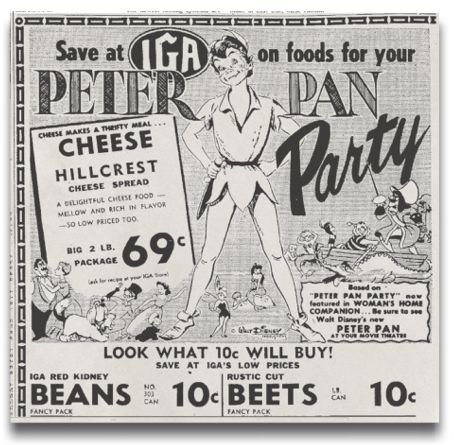
IGA Supermarkets and other food chains promoted having a Peter Pan Party, which tied into an article published in the magazine Woman's Home Companion.
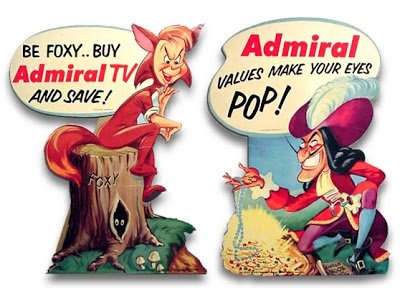
Previously at 2719 Hyperion, we featured components of the advertising campaign for Admiral Appliances that also made use of the Peter Pan cast.
There was certainly much more to Peter than just peanut butter . . .


-
Snapshot! - The Crocodile and the Vane
Posted: 2011-06-15 08:02:56 UTC-04:00
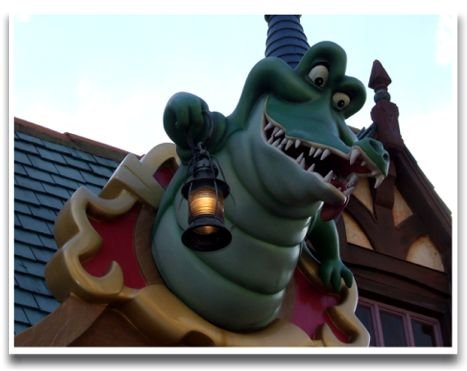
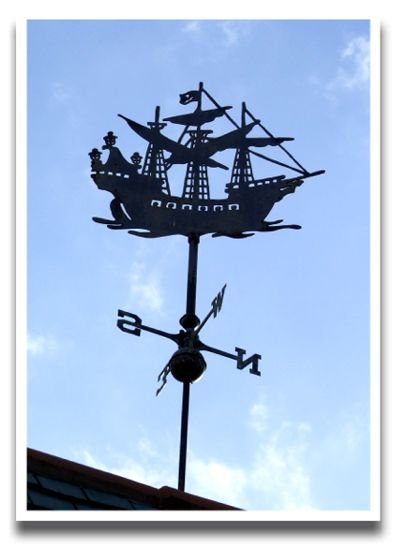
In continuing our celebration of Peter Pan this week, we travel today to the Magic Kingdom at Walt Disney World. Two of my favorite Fantasyland details relate to the architecture of Peter Pan's Flight. Tick-Tock the crocodile guards over the attraction's exit, likely on the lookout for any sign of the villainous Captain Hook. Perched above the croc on a nearby rooftop is a weather vane that cleverly takes the shape of Hook's pirate ship.
Of note--Tick-Tock is an unofficial nickname for the character. Official Disney texts simply identify the beast as "the Crocodile."

-
Walt Disney's Surprise Package: Peter Pan and the Pirates
Posted: 2011-06-14 09:41:32 UTC-04:00
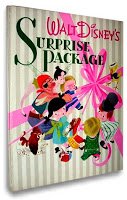
Previously here at 2719 Hyperion, we featured material from the 1944 storybook collection Walt Disney's Surprise Package. This Simon and Schuster publication is especially notable in that it showcased stories from animated projects then still in production at the Walt Disney Studios. Included in the anthology is Peter Pan and the Pirates, which preceded the actual animated feature by close to a decade.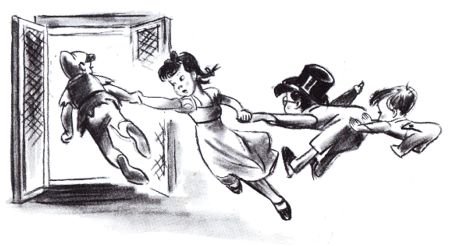
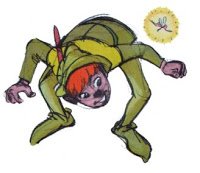 Peter Pan and the Pirates is an abbreviated tale, likely derived from whatever story notes and concepts that had been produced by the studio at that time. In the story, Peter takes the children to Neverland where they meet the Lost Boys and briefly spy on Captain Hook and learn of his connection to the alarm clock ticking crocodile. All but Peter are later captured by Hook. The story ends with Peter's daring rescue of his friends and his final confrontation with Hook.
Initially, Wendy, John and Michael are wholly ignorant of Peter Pan and Neverland. It is Mrs. Darling who first sees Peter Pan in the nursery and tucks his shadow away for safe keeping. This connection between Peter and Mrs. Darling is actually more faithful to Barrie's original story:"But George . . . last night, Nana's night out, I was drowsing here by the fire, when suddenly I saw that boy . . . in the room! I screamed. Just then, Nana came back. She sprang at him, but too late. The boy leaped for the window and was gone!"
Mr. Darling looked at his watch. "Come, dear, we're late. We haven't time for this foolishness tonight."
"Wait," said Mrs. Darling. "The boy escaped, but his shadow hadn't time to get out. Down came the window and cut it off! I picked it up and and put it there in the bottom drawer." She pointed to the bureau.
Mr. Darling laughed aloud. "Your head is always so full of stories you're beginning to believe them yourself."Tinker Bell's role had yet to be developed. Her participation in the story is minimal and the key story element of her jealousy of Wendy is completely absent. Even the concept of pixie dust bestowing the power of flight was not yet present.
One strange concept that did not survive to the final film was the toxic nature of Hook's tears:The pirates dragged the children off. Now Hook was ready for his prey. Smacking his lips, he whipped out his dagger. He squeezed himself into the nearest tree trunk and wriggled his way to the bottom. But there he stuck. He was too big to go any further. He couldn't reach Peter, who was sleeping right in front of him by the fire. The sight of his happy face made Hook shake with rage. His iron claw twitched. Two fiery red spots blazed up in the centers of his blue eyes. Hot angry tears sizzled down his cheeks. They splashed into Peter's medicine in the sea-shell on the shelf just below.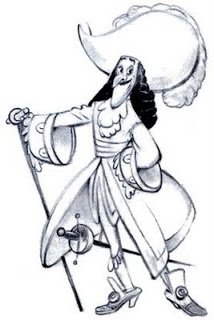
Hook watched them. The corners of his mouth turned up in a villainous smirk. He knew that the tears from his red spots were poison! "I've got you this time, Peter Pan!" He hissed.In the original Barrie story, Hook simply dispatches a generic (but virulent) poison into Peter's medicine. Tinker Bell saves Peter by drinking the medicine and is later revived by the worldwide hand-clapping of little children professing their belief in fairies. In the Surprise Package story, Tink simply informs Peter of the poison and he believes her. In the final film, the poison is replaced with a time bomb which very nearly dispatches Tink, but she subsequently revives and without the need of juvenile applause.
In Peter Pan and the Pirates, the final battle between Peter and Hook ends on an odd and somewhat anticlimactic note: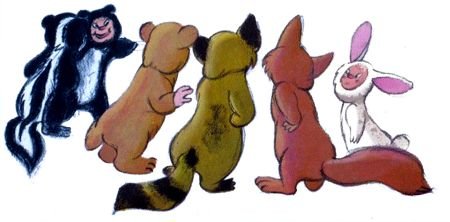
Steel blades flashed! It was Peter Pan against Captain Hook! The fight to the death was on! But the fight was short. Peter thrust with blinding, dazzling speed. Hook was no match for him. His sword slipped from his hand. It crashed to the deck.
All of the stories in Walt Disney's Surprise Package, including Peter Pan and the Pirates, were adapted by H. Marion Palmer (who was interestingly enough the first wife of Theodor Geisel, aka Dr. Seuss). The artwork, including the examples reprinted here, were credited simply to the Walt Disney Studio.
Peter stooped down and picked it up. He handed it back to the pirate with a joyous, cocky smile.
This was too much for Captain Hook. He could not face that hated smile! He stalked to the ship's edge. with a last flourish of his hideous claw, he climbed the rail. He jumped. Down splashed Captain Hook into the black lagoon! He did not dream that the crocodile was waiting for him. The beast had given no warning, for the clock inside of him had a last run down.
Explore the 2719 Hyperion Archives:
Walt Disney's Surprise Package: Happy Valley
Walt Disney's Surprise Package: Lady


-
Celebrating Peter Pan!
Posted: 2011-06-13 05:59:28 UTC-04:00
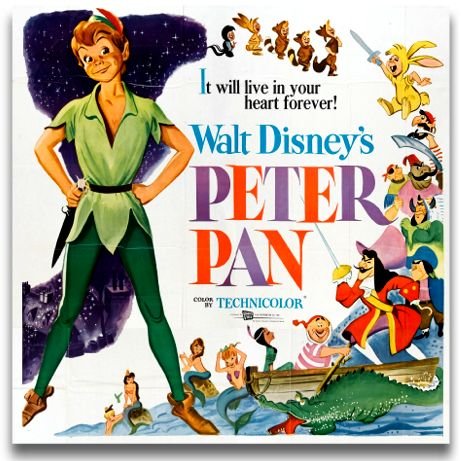
Summer is here and our first major vacation destination? Neverland!
 All this week we will be celebrating Walt Disney's 1953 animated feature Peter Pan here at 2719 Hyperion. The inspiration behind this examination originated with Nate Parrish and Matt Parrish, hosts of the very popular and always excellent Disney-related podcast WEDway Radio. Nate and Matt invited me to be a guest on their most recent episode of WEDway Radio, and our topic of choice was Walt's interpretation of the J. M. Barrie classic.
Our discussion was wide and varied, covering everything from the original J. M. Barrie source material and Walt's own personal connections to the story, to the film's emergence as a quiet but still very powerful Disney franchise. It was a fun and entertaining discussion and is well worth a listen.
Download links for WEDway Radio Episode 74 can be found at the WEDway Radio home page.
There is also other interesting Peter Pan material to discover in the 2719 Hyperion Archives.
Explore the 2719 Hyperion Archives:Vintage Headlines: Santa Claus and Walt Disney on the Same Day

-
Posted: 2011-06-11 06:24:15 UTC-04:00
Saturday at the Archives: Stargazing at Mickey's Gala PremierStargazing at Mickey's Gala PremierBy Jeffrey PepperOriginally published August 5, 2008
Who was who in Hollywood in 1933? You need only look as far as the Mickey Mouse cartoon Mickey's Gala Premier for the answers. Released on July, 1, 1933, it featured over forty caricatures of motion picture celebrities. In the short, all of Tinseltown turns out for the premiere of "Galloping Romance," a short-within-the short remake of Gallopin' Gaucho.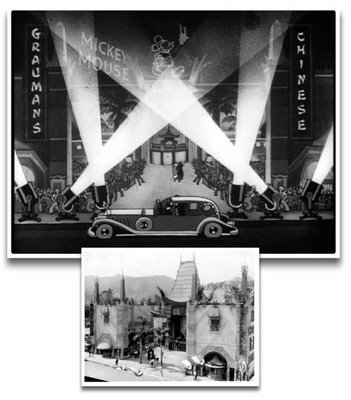 The momentous event was held at the famous and now iconic Grauman's Chinese Theater, located at 6925 Hollywood Boulevard. Famous for its forecourt celebrity footprints in cement, the theater was built by showman Sid Grauman, whose partners in the endeavor included Mary Pickford, Douglas Fairbanks and Howard Schenck. It opened on May 18, 1927 with the premiere of the Cecil B.DeMille film The King of Kings. In 1989, the theater's front facade and forecourt were recreated as the entrance to the Great Movie Ride at the Disney-MGM Studios in Walt Disney World.
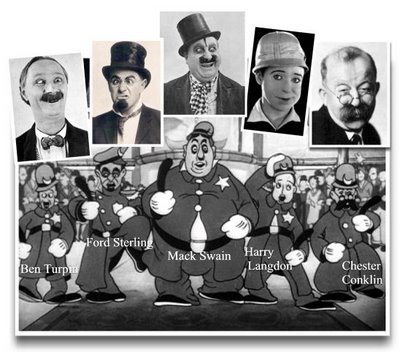 Mickey's Gala Premier was just five years removed from Hollywood's silent era, and so it's not surprising that numerous silent film stars are featured in the short. Director Burt Gillette and his crew reached back nearly two decades when they included five of the Keystone Cops. Numerous individuals throughout the silent era were members of Mack Sennett's group of slapstick players. Mickey's Gala Premier showcased four of the more famous officers: Ben Turpin, Ford Sterling, Max Swain and Chester Conklin. The Cop between Swain and and Conklin has been identified by some sources as Harry Langdon. Langdon was a silent film comedian who worked for Mack Sennett but was never cast as a Keystone Cop.
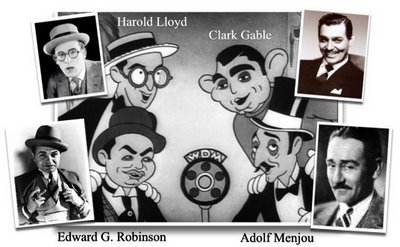 Another famous silent film comedian, Harold Llyod, is joined at the radio microphone by actors Edward G. Robinson, Adolf Menjou and Clark Gable. Robinson appears as the character Rico from his 1931 movie Little Caesar.
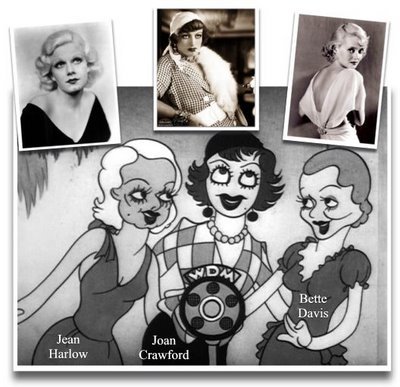 Three of the era's best known starlets took their turn at the microphone: Jean Harlow, Joan Crawford and Bette Davis. Crawford appeared in the costume of her character Sadie Thompson from the 1932 film Rain.
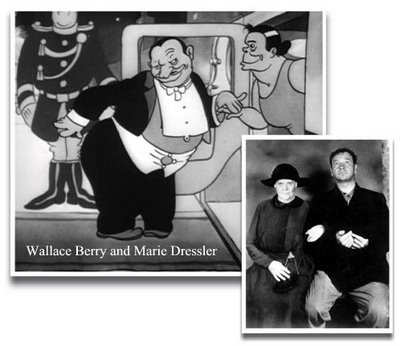 The biggest draw at the box office in 1933 was Marie Dressler who appears in the cartoon with her frequent co-star Wallace Berry. The two had then recently worked together in the films Dinner at Eight and Tugboat Annie. Their most famous pairing was the 1930 movie Min and Bill, for which Dressler won an Academy Award for Best Actress. That movie was also the inspiration for Min and Bill's Dockside Diner, a counter-service restaurant at Disney's Hollywood Studios.
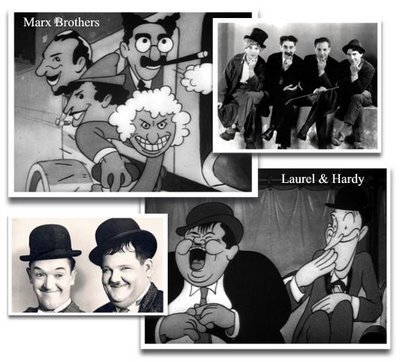 Famous then and famous now are the Marx Brothers--Groucho, Harpo, Zeppo and Chico--and Stan Laurel and Oliver Hardy.
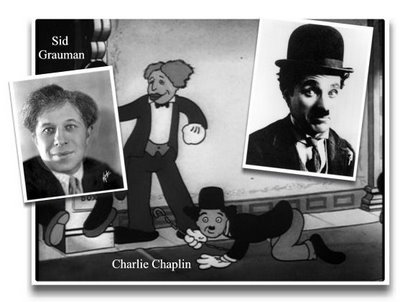 In his guise as the Little Tramp, Charlie Chaplin attempts to sneak past theater owner Sid Grauman.
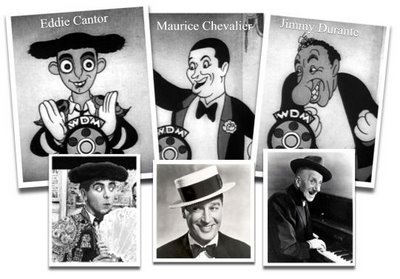 Eddie Cantor appears in his role from The Kid from Spain, released in 1932. Maurice Chevalier and Jimmy Durante also take turns at the radio microphone. In the 1960s, Chevalier would appear in the Disney live-action films In Search of the Castaways and Monkeys Go Home. He also recorded the title song for The Aristocats shortly before his death in early 1972.
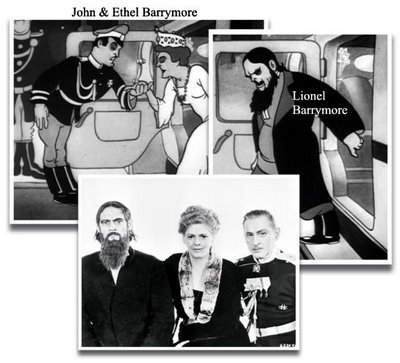 The Barrymore siblings, Lionel,Ethel and John, appear in their roles from the 1932 movie Rasputin and the Empress.
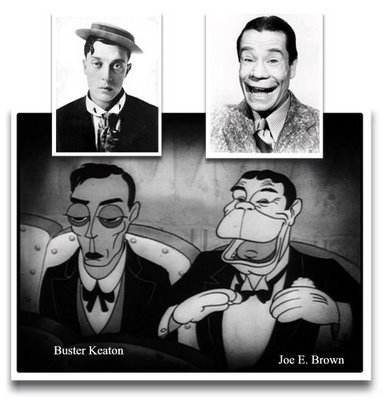 The perpetually morose Buster Keaton does not share a laugh with famous big mouth Joe E. Brown.
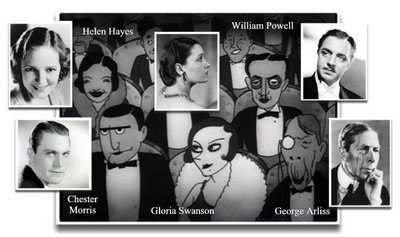 Helen Hayes had just won an Academy Award in 1931 for her performance in The Sin of Madelon Claudet. She is seated nearby to Chester Morris, Gloria Swanson, George Arliss and William Powell. The following year, Powell would assume his most famous role of Nick Charles in The Thin Man. Morris would become famous a decade later for his series of Boston Blackie movies.
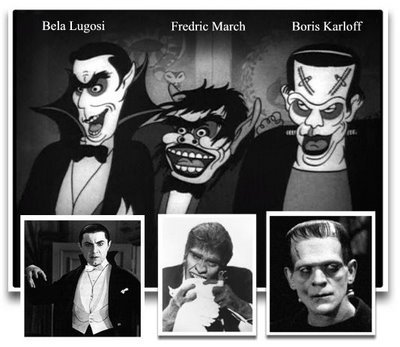 Classic monsters Dracula, Mister Hyde and the Frankenstein monster, as portrayed by Bela Lugosi, Fredric March and Boris Karloff respectively, display their more jovial sides.
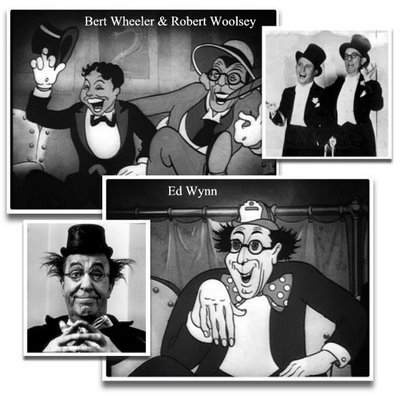 Bert Wheeler and Robert Woolsey are largely unremembered today, despite being one of the most popular comedy acts of the 1930s. Ed Wynn is well known to Disney fans for his roles in films such as Mary Poppins, That Darn Cat, The Gnome-Mobile and Alice in Wonderland.
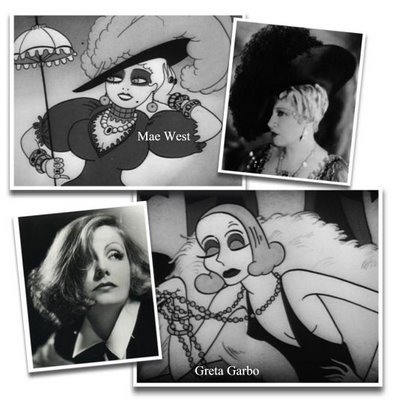 Mae West recreates her persona from the movie She Done Him Wrong. She invites Sid Grauman to "Come up and see me sometime." Greta Garbo was one of the decade's most famous leading ladies.
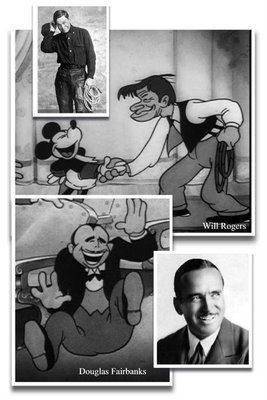 Will Rogers lasso's Mickey while Douglas Fairbanks is overcome with laughter and begins rolling in the aisle. Rogers appears in the The American Adventure at EPCOT.
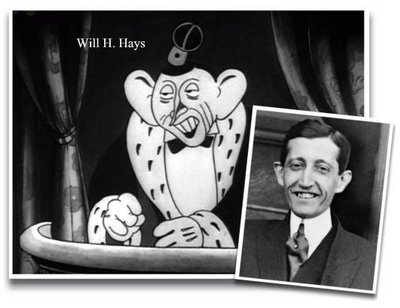 Disney animators were none too kind when they created this caricature of Will H. Hays. Famous for the Hays Code, he was the first president of the Motion Picture Producers and Distributors of America, the forerunner of the current MPAA. He was known in Hollywood as the "Censorship Czar," thus explaining his costumed appearance in the cartoon.
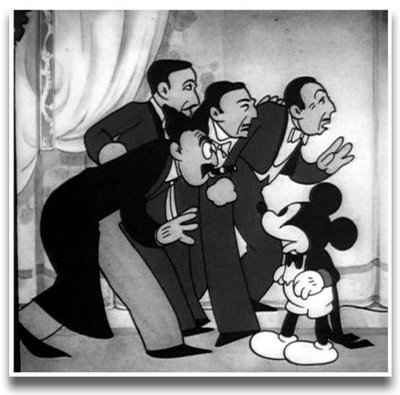 And who are these three gentlemen standing next to Groucho Marx in one of the shorts final scenes? The one on the right bears a very strong resemblance to certain famous cartoon-maker of the era. Hmm . . .
Images © Walt Disney Company


-
The Streets of L.A. Noire
Posted: 2011-06-09 08:44:43 UTC-04:00
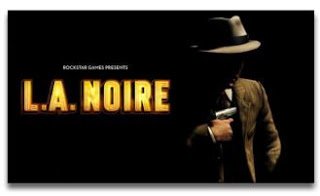 Of late, I have become quite immersed in the recently released videogame L.A. Noire. And although a discussion of the subject would be better suited to my neglected sister blog Boom-Pop!, I find myself more interested in playing six degrees of Hyperion and relating the certainly very obscure connections to my own research efforts that I found within the game's expansive recreation of Los Angeles circa 1947.
I have spent an enormous amount of time over the past few years via testimonials and photographs, attempting to visualize in some way the Los Angeles that existed during Disney's Hyperion days, and also explore the area's iconography that inspired the Imagineers who created the initial designs for Disney-MGM Studios. To free roam within a virtual replica of a place I have extensively explored on an academic level has been a great deal of fun to say the least.
The setting of L.A. Noire is a decade removed from Disney's Hyperion days, and unfortunately does not as yet include the Silver Lake and Los Feliz neighborhoods which were central to the studio's early history. I've as yet only completed about 50% of the game but I have bumped into a few landmarks that relate to the architecture of the Hollywood Studios park at Walt Disney World. The Brown Derby, the Max Factor building, the Crossroads of the World and Grauman's Theatre can all be found with L.A. Noire's virtual landscape.
The oddest bit of game to blog synergy happened when, during gameplay, I discovered the RKO Theatre. I had recently published a Window to the Past here at 2719 Hyperion that showcased that theater's location on Hill Street in downtown Los Angeles. Upon seeing the theater within the game, I quickly pulled my police car over to the curb, and ran down the street to find the area that what documented in the photograph I had featured. Here is what I saw:
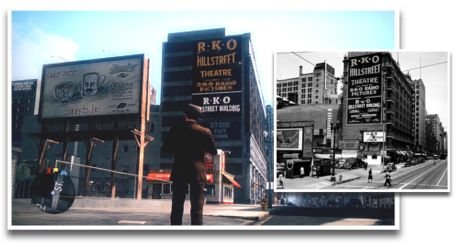
Just a little bit of fun I'd thought I'd share. Please do not judge my momentary over-the-top geekiness too harshly.


-
Vintage Snapshot! - Bongo and Lulubelle
Posted: 2011-06-08 17:20:23 UTC-04:00
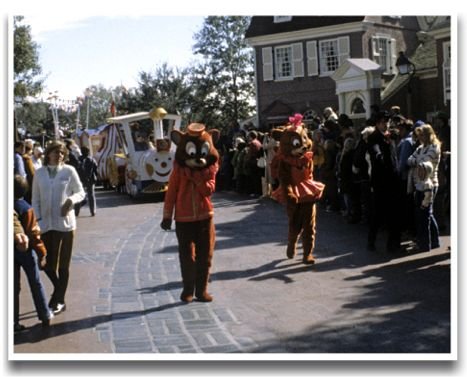
Back in the late 1970s, the Disney character canon was not as densely populated as it is today. Hence, the visibility of two characters who were rarely seen in theme park-costumed finery--Bongo and his lady friend Lulubelle. Both characters were born from the Bongo segment of the 1947 animated feature Fun and Fancy Free, which was in turn based on a short story by Sinclair Lewis. In this Vintage Snapshot, Bongo and Lulubelle stroll through Liberty Square as part of Dumbo's Circus Parade. The circus theme is likely the reason for their inclusion; Bongo was a circus bear who escaped into the wilderness where he eventually met and fell in love with Lulubelle.

-
Freeze Frame! - A Slightly Visible Scar
Posted: 2011-06-07 07:33:35 UTC-04:00
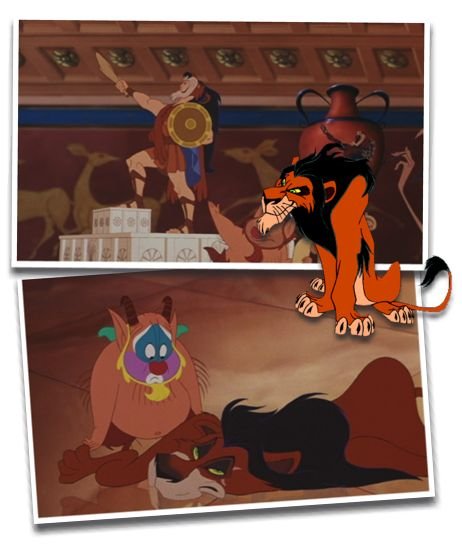
Today we continue our Freeze Frame! exploration of Disney's 1997 animated feature Hercules. For a brief moment in the film, Hercules is seen posing for an artist while wearing a lion skin. The lion skin just happens to belong to one of Disney's more notorious animated villains--Scar, from The Lion King. Scar's features become more recognizable a few moments later when Herc unceremoniously throws the pelt on the floor in front of Phil. The satyr then uses it to wipe clown makeup from his face. Oh, how the mighty had fallen.

-
Vintage Headlines: Keep Running. We're Brothers
Posted: 2011-06-05 19:13:03 UTC-04:00
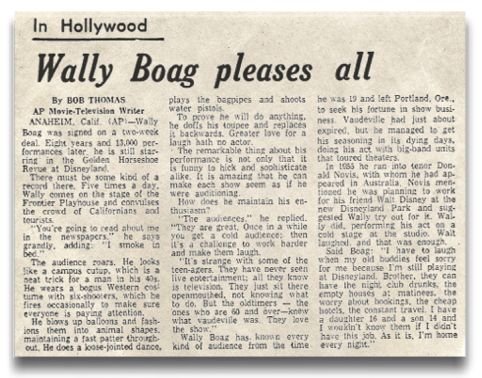
The remarkable thing about his performance is not only that it is funny to hick and sophisticate alike. It is amazing that he can make each show seem as if he were auditioning.
Bob Thomas, June 21, 1963
INCIDENTALLY, a funny fellow by the name of Wally Boag ought to take his place one day soon up there with such comic greats as Bob Hope, George Gobel and Jack Benny. Young Wally, a sly ad-libber, absolutely kills the people with his balloon tricks and dancing during the performances daily In Disneyland's Pepsi-Cola Golden Horseshoe Theater.
Syndicated columnist Tedd Thomey, December 10, 1955
WALLY BOAG, the comedian who costars with Betty Taylor and Donald Novis in the Golden Horseshoe frontier show, has been featuring a unique balloon act since the early '40s. Wally always ends his show by giving a youngster in the audience the dog or elephant careicature he has created from the balloons. "After the war," Wally says, "I played for 54 weeks in a musical revue in London. "During my act, I'd call a 12-year-old girl out of the audience—always the same girl—and give her the balloons. I'd ask her if she entertained and she would say 'Yes, I sing and off she would go into her numbers. "It was 10 years before I saw that girl again, but I still was doing the balloon act, so I handed her a balloon. It was back stage in New York and Julie Andrews was starring in "My Fair Lady.' "
Syndicated Columnist Vera Williams, September 18, 1958
Wally Boag, who has worked four years in the park's Golden Horseshoe Frontier saloon, made this comment: "He's one of the greatest laughers I've ever played to." The king literally doubled up with laughter at Boag's gag about the two rabbits being chased by a pack of wolves. One rabbit says: "Shall we keep running or stop and outnumber them? The other rabbit replied: "Keep running. We're brothers."
AP report of Belgium King Baudouin's visit to Disneyland in 1959

-
Posted: 2011-06-05 06:47:16 UTC-04:00
Saturday at the Archives: Museum of Modern MarvelsMuseum of Modern MarvelsBy Jeffrey PepperOriginally published May 29, 2008
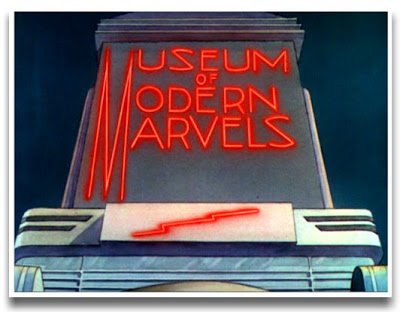 The future frequently envisioned in the 1930s was a bright and shining place, filled with tall skyscrapers and mechanical automatons that took even the most common laborious tasks and functions out of the hands of
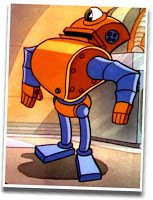 the common citizens. It was a great big beautiful tomorrow as presented in films such as Metropolis and Things to Come and a popular culture phenomenon that ultimately culminated at decade's end in the World of Tomorrow presented at the 1939-1940 New York World's Fair.
Donald Duck experienced that particular vision of the future for a brief time in 1937 when he visited the Museum of Modern Marvels in the cartoon Modern Inventions. It was released on May 29th of that year.
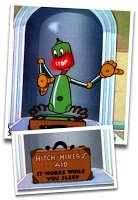 The Museum, like much of era's pop culture futurism, what not so much a showcase of emerging technologies but a series of robotic appendage-based contraptions designed to perform the mundane rather than the magnificent. Hydraulic potato peelers, pneumatic pencil sharpeners and robot nurse maids were among the exhibits within the halls of the museum's sleek, streamline moderne architecture. No doubt many members of the cartoon's audience, as they were then emerging out of the throes of the Great Depression, could dream of owning a robot butler, despite Donald's own exasperation with the one that haunted his steps as he toured the museum.
A standard archetype of these earlier era future visions and also present in Modern Inventions is the robotic barber chair. Donald comically gets his tail trimmed and head polished by the friendly automation. Disney would in fact revisit that concept and the whole of 1930s futurism some forty years later in a set piece of the Horizons attraction at EPCOT Center.
 Fleischer Studios, home of Popeye and Betty Boop, would also explore similar themes in 1938 with the short All's Fair at the Fair, a cartoon that anticipated the upcoming New York World's Fair. It as well featured an automated robot-based shave and a haircut sequence.


-
What a Character! - The Mountain Lion
Posted: 2011-06-03 00:10:13 UTC-04:00
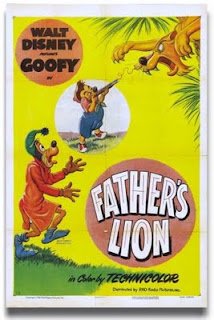 The twilight of animation's golden age is littered with potential cartoon stars that sadly faded with their medium. Numerous new characters were born out of the 1950s-era Disney shorts, but most were simply not granted enough time to establish themselves. One such case study involves a character who, despite starring in five different cartoon shorts, did not even earn a name for himself--literally. In historical texts, he is simply the "the Mountain Lion," although he has unofficially been identified by some scholars as Louie. For practical reasons, we will apply that monicker for the purposes of our discussion here.
Louie was introduced in the 1950 Donald Duck cartoon Lion Around. He is an undomesticated creature, an inarticulate denizen of the forest, but certainly not in the benign and harmless fashion of Humphrey Bear, who was also a product of the same time period. In Lion Around, the nephews attempt to fool Donald with a mountain lion disguise, which of course leads inevitably to an encounter with the real McCoy. In Hook, Lion and Sinker, Louie gains more of a comical edge and a personality bordering on buffoonery. He and his young cub attempt to steal fresh fish from Donald, and their antics bring to mind Disney's coyote characters, Bent-Tail and Bent-Tail, Junior.
The Mountain Lion's finest moments would however be achieved with a different co-star. He shared the screen with Goofy in both with 1950's Lion Down and its 1952 followup, Father's Lion. Lion Down brings the lion to the city where he has to deal with a blissfully ignorant Goofy. In Father's Lion, a true Goof classic, Louie again falls victim to Goofy's exaggerated and wholly unintentional bravado, and Goofy Junior's always dead-on aim with his pop gun.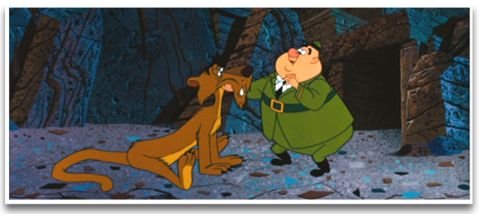
Louie's final appearance was in the Cinemascope cartoon Grand Canyonscope, where he reunites with Donald Duck and encounters J. Audubon Woodlore, who has been displaced from his usual patrols at Brownstone National Park. It is a widescreen tour de force of sight gags and pratfall comedy, of which Louie is a prominent player.
Disney historian John Grant described the Mountain Lion as, "a rather anonymous character," and noted that, "this indeed was his strength, for it was as a mysterious lurking presence that he had his greatest effect." And it was through such anonymity that he has at least happily gained some degree of historical notoriety.


-
Consider the Source on Storyboard
Posted: 2011-06-04 09:15:48 UTC-04:00

I am very happy to announce that my recent 2719 Hyperion article, Consider the Source: A Life in the Woods, has been reprinted on Storyboard, the official blog of the Walt Disney Family Museum. During the month of June, the Museum is celebrating Bambi with screenings and other activities. It's quite an honor to be associated with the Museum in this manner. My thanks to Jeff Kurtti and the Museum staff for affording me this opportunity.

-
Freeze Frame! - Haunted Muses
Posted: 2011-05-31 09:15:14 UTC-04:00

In a very quick bit of theme park to motion picture synergy, an element of the Haunted Mansion is referenced in Disney's 1997 animated feature Hercules. During the musical number I Won't Say (I'm in Love), the Muses take the forms of various sculptures as they provide background vocals for Meg's performance. At one point in the song, they are featured as a set of marble busts that bear an uncanny resemblance to a similar and rather famous set piece from the Haunted Mansion's cemetery.

-
Service With Character: Memorial Day Edition
Posted: 2011-05-30 06:15:04 UTC-04:00
In honor of the Memorial Day holiday, we are presenting a special edition of our very popular 2719 Hyperion Exhibition Hall series Service with Character: Disney World War II Insignia. Today we feature twelve emblems collected from 1944 issues of Walt Disney's Comics and Stories.
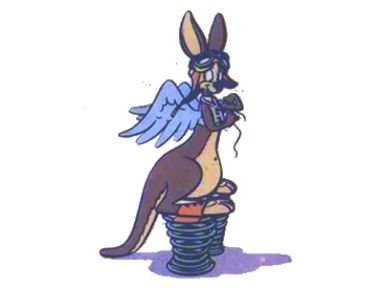 32nd Sqd. Air Training Corps
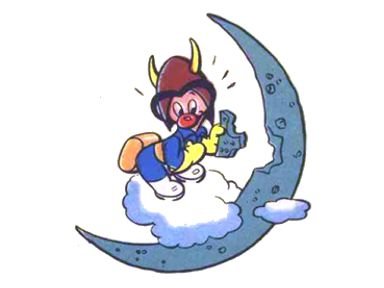 494th Base Headquarters and Air Base Squadron
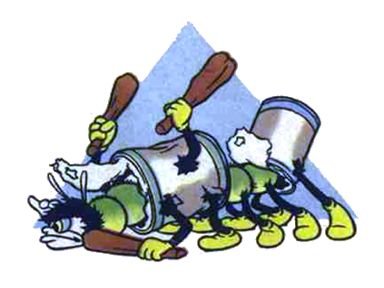 Co C 714th Tank Btn. 12th Armored Div.
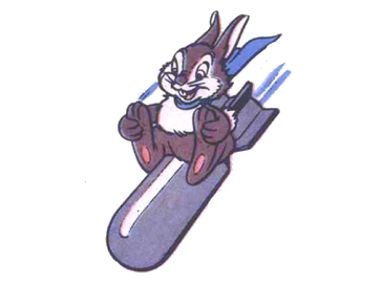 799th Bombardment Squadron
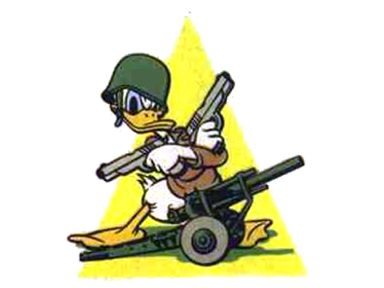 881st Field Artillery Battalion
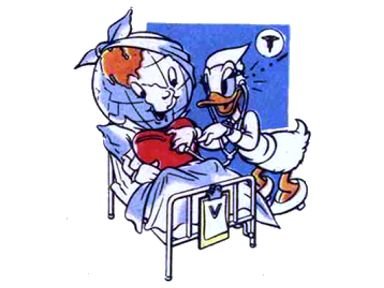 Army Nurse Corp
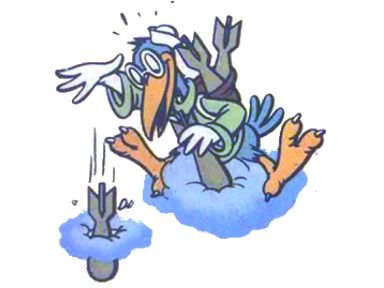 Bombing Squadron 102
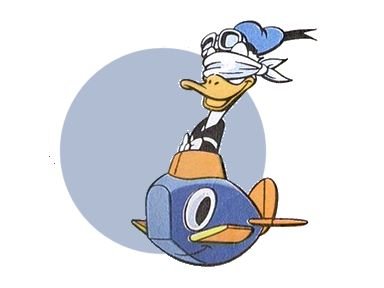 Hq. Sq. 41 MBDAG-41
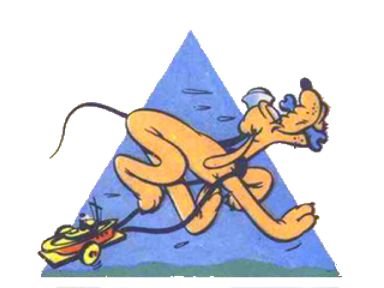 Ships Repair AD-40
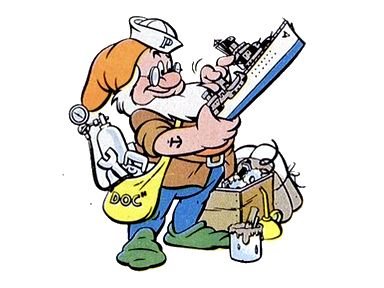 U.S.S. Piedmont
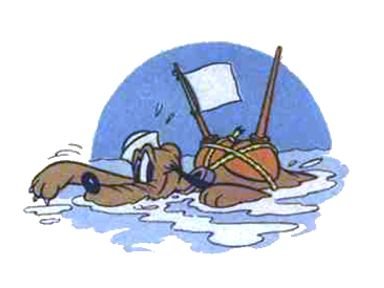 U.S.S. Sapelo
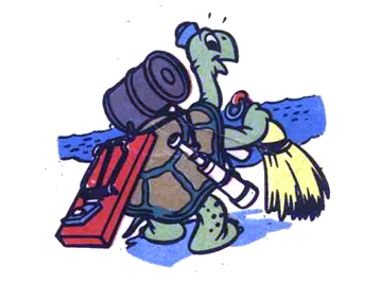 U.S.S. YMS 329
Explore the 2719 Hyperion Exhibition Hall:Service With Character: Whimsical Thought and Serious Intent

-
Posted: 2011-05-28 05:10:13 UTC-04:00
Saturday at the Archives: Disney's Hollywood-The Pan-Pacific AuditoriumDisney's Hollywood: The Pan-Pacific AuditoriumBy Jeffrey PepperOriginally published February 20, 2008
I must admit I have a very strong sentimental attachment to the moniker Disney-MGM Studios. But I'm really warming up quickly to its new Hollywood identification.
Let's face it, there is a lot more Hollywood than MGM in the Disney Studios at Walt Disney World. Much of the theming of the resorts third gate is embodied in idealized architecture that is rooted in the southern California environment from which Disney entertainment emerged. When Walt Disney created a letterhead in 1923 that listed his uncle Robert Disney's Hollywood address at 4406 Kingswell Avenue, it was the genesis of a geographical dynamic that would inspire the elaborate design of a central Florida theme park nearly sixty-five years later.
 As part of a new ongoing series here at 2719 Hyperion, we are going to show you the true Hollywood behind Disney's Hollywood Studios. And we are going to begin this parkeological expedition at the recently rechristened front entrance to the park.
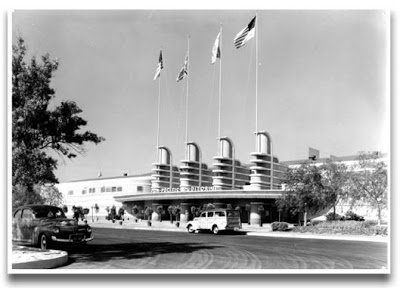 The entrance area to Disney's Hollywood Studios and the architecture surrounding the ticket kiosks were inspired by the Pan-Pacific Auditorium, an arena-entertainment venue that served the Los Angeles area for close to forty years. The Studio's entrance facade recreates that building's own front entrance and its distinctive four towers. The towers reflected a sleek, aircraft-inspired look, and each was crowned with a high-reaching flagpole and corresponding flag or pennant. It opened on May 18, 1935 and was the first major commission for architecture partners Walter Wurdeman, Charles F. Plummer and Welton Becket. Three decades later, Becket would partner with United States Steel and Disney in creating the design for the Contemporary Resort at Walt Disney World.
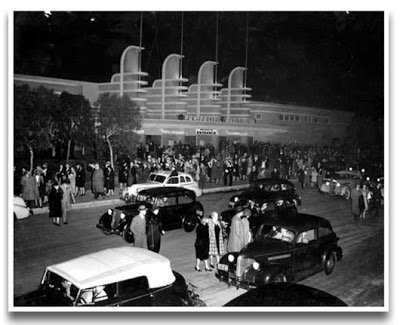 The Pan-Pacific was one of the more famous examples of Steamline Moderne design, an extension of Art Deco that became prominent during the mid-1930s. The style proved especially popular for much of the architecture created for the 1939-1940 New York World's Fair. The style's influence could be seen in the art direction of films such as Lost Horizon and The Wizard of Oz, and also in the designs of consumers products including appliances, automobiles and trailers.
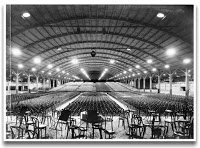 Up until the opening of the Los Angeles Convention Center in 1972, the Pan-Pacific Auditorium was the primary indoor venue for the city and its surrounding population. The interior itself encompassed 100,000 square feet and could seat close to 6,000 individuals. It played host to trade and consumer shows, circuses, concerts, ice shows and political functions, and was also a home for sporting events including basketball, hockey, tennis and wrestling. Dwight D. Eisenhower, Richard Nixon and Elvis Presley were among the many notable figures that appeared there.
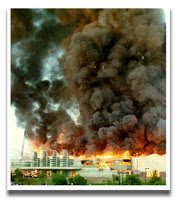 Following its closing in 1972, the building sat vacant and neglected. It gained a temporary degree of notoriety in 1980 when it was featured in the film Xanadu, but quickly faded again from public notice shortly thereafter. Its deterioration continued nearly unchecked for almost another decade. Then on May 25, 1989, just three weeks after the debut of Disney-MGM Studios and its Pan-Pacific-inspired entrance, the once famous southern California landmark was destroyed in a spectacular fire. The location has since become the Pan-Pacific Park, administered by the Los Angeles Department of Recreation and Parks. The architecture of the facilities recreation center recreates in part the auditorium's entrance design, albeit on a much smaller scale.
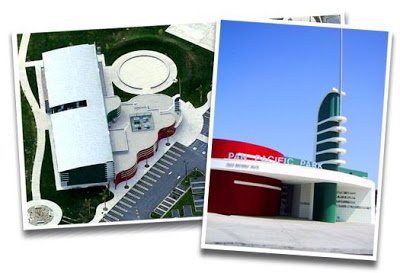 The Pan-Pacific Auditorium entrance design will be recreated again in the near future at Disney's California Adventure. The look of its front entrance area will soon emulate that of Disney's Hollywood Studios, in a re-imagining that is intended to evoke the setting of southern California in the 1920s and 1930s.


-
Vintage Headlines: Disneyland Summer Reading
Posted: 2011-05-26 05:27:52 UTC-04:00
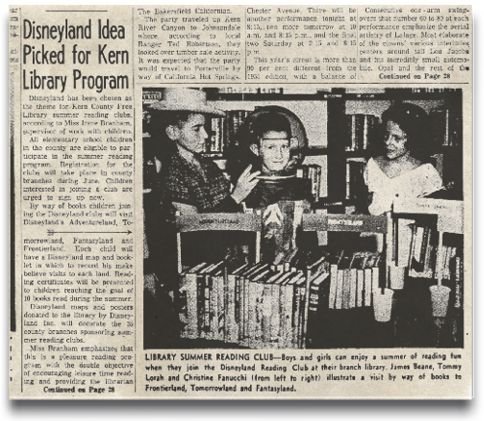
Here's a fun slice of 1950s pop culture with a Disney spin.
Kids have been nagged about summer reading for decades; in 1956, the librarians of Kern County, California came up with a clever twist to encourage their young patrons to crack open the books--a Disneyland-themed summer reading program. The details were provided in this newspaper article from June 14th of that year:Disneyland has been chosen as the theme for Kern County Free Library summer reading clubs according to Miss Irene Branham, supervisor of work with children. All elementary school children in the county are eligible to participate in the summer reading program. Registration for the clubs will take place in county branches during June. Children interested in joining a club are urged to sign up now.By way of books, children joining the Disneyland clubs will visit Disneyland's Adventureland, Tomorrowland, Fantasyland and Frontierland. Each child will have a Disneyland map and booklet in which to record his make-believe visits to each land. Reading certificates will be presented to children reaching the goal of 10 books read during the summer. Disneyland maps and posters donated to the library by Disneyland Inc. will decorate the 35 county branches sponsoring summer reading clubs. Miss Branham emphasizes that this is a pleasure reading program with the double objective of encouraging leisure time reading and providing the librarian with an opportunity to give reading guidance to young patrons. The library's vacation loan, allowing children to borrow eight books for a period of six weeks, will enable children to continue reading for the club during the family vacation. Children and their parents may get further information about the summer reading program by visiting any branch of the Kern County Free Library.

-
Vintage Snapshot! - Caballeros in Revue
Posted: 2011-05-25 05:25:51 UTC-04:00
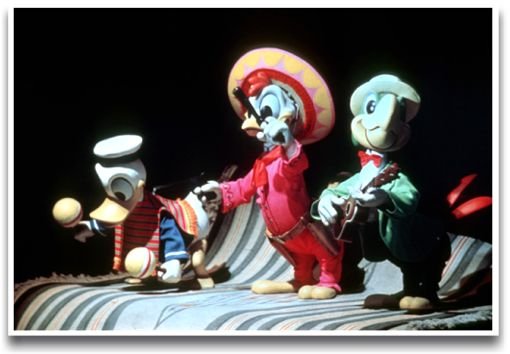
Decades before they appropriated the River of Time at EPCOT, Donald, Jose and Panchito first performed at Walt Disney World in the rather short-lived Fantasyland attraction, The Mickey Mouse Revue. The audio-animatronic trio performed their namesake song as part of the production. After a nine-year tenure in Florida, the show was exported to Tokyo Disneyland where it enjoyed a much longer lifespan, closing just recently in 2009.


FeedBurner delivers the world's subscriptions wherever they need to go. Publish a feed for text or podcasting?
You should try FeedBurner today.